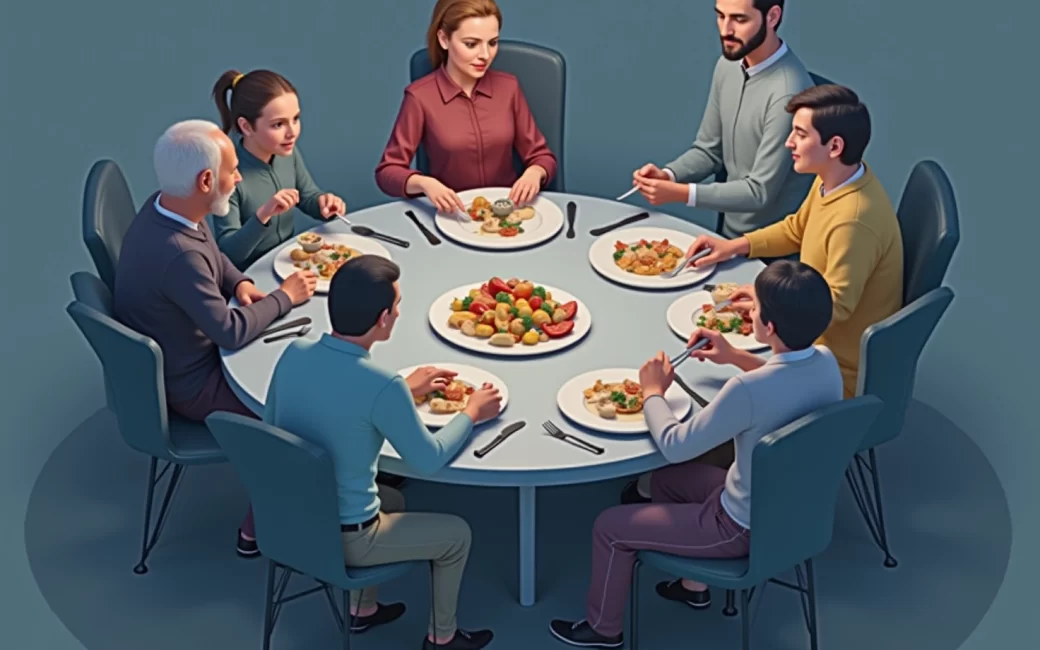
When Family Conflict Turns Into Estrangement
Family conflict usually starts small — a missed invitation, a comment at a holiday dinner, a grievance that never gets named out loud. One widely shared account describes a woman who found out only after the fact that her daughter-in-law had planned a family trip without her, and had to decide whether to let the slight pass or say something about it (Bright Side). That kind of exclusion is not yet estrangement. It becomes estrangement when contact doesn't resume on its own — when the lapse stretches from weeks into months, neither side initiates repair, and the silence starts to feel like the new normal rather than a pause.
The distinction matters because the two call for different responses. A single excluded event is a grievance that can often be raised directly with the person involved. A pattern of lapsed contact, repeated avoidance, or a standing refusal to be in the same room is a relationship that has already changed shape, and raising it with the excluding relative alone rarely resolves it.
Signs the pattern has crossed into estrangement rather than a passing conflict:
- Contact has stopped for months, not days, with no attempt from either side to restart it
- The reason for the silence was never discussed, only inferred
- Other relatives have been drawn in to take sides or carry messages
- Attempts to bring it up are deflected or shut down rather than addressed
When conflict has calcified into this kind of standoff, a structured third party is often the only way to get both people back in a room. Licensed family counseling services exist for exactly this — providers such as the Family Counseling Service of the Finger Lakes are organized specifically around relationship and family therapy rather than individual mental health treatment (NYSED provider listing). A reader trying to decide whether a rift needs that kind of help can use a simple test: if the two of you can't yet agree on what happened, a counselor's first job isn't to fix the relationship — it's to get a shared account of the conflict on the table.
When a Family Member Dies: What an Obituary and Service Are Expected to Cover
An obituary exists to do two things at once: record who someone was, and tell the living community where and when to gather. That second function is why so many family-related notices online are, structurally, about death — the obituary is often the only document that lists an entire family tree in one place, naming parents, spouses, children, and siblings by name and relationship.
A typical notice, such as the one published for Ruby Yvonne Meng, follows a consistent pattern: it opens with the person's full name and dates, moves through a short account of their life, then lists surviving family members by relationship before closing with service details (Meng Funeral Home). The obituary for Jordan Mark Ricker follows the same structure — biography, surviving relatives, service arrangements — which suggests this is a convention of the form rather than one funeral home's choice (Hanneman Funeral Homes).
What a reader looking at one of these notices can expect to find:
- The deceased's full name, birth date, and date of death
- A brief biography — where they lived, worked, and who they married
- A list of surviving family, usually ordered spouse, children, siblings, then grandchildren
- The date, time, and location of the funeral or memorial service
- Where memorial donations may be directed, if specified
The "service" in a funeral notice is distinct from family counseling in the earlier sense — it's a scheduled, public gathering, not a therapeutic one — but both are organized around the same unit: the people who count as family to the person at the center of the notice.
What Does "Family" Actually Mean?
At its narrowest, family means people connected by blood, marriage, or adoption — the definition used in law, census forms, and most obituaries' lists of survivors. That's the sense doing the work in the examples above: a daughter-in-law, a surviving spouse, a sibling named in a will.
But that definition answers a narrower question than most people are actually asking when they use the word. Kinship (who you're related to) and household (who you live with) are not the same thing, and a lot of confusion about family comes from treating them as interchangeable. A grown child living across the country is still kin but no longer part of the household; a long-term partner sharing a lease may be part of the household well before any legal tie exists.
Within kinship itself, the word covers several overlapping groups:
- Nuclear family — parents and their children, as a self-contained unit
- Extended family — grandparents, aunts, uncles, and cousins included
- Blended family — formed when parents with children from earlier relationships combine households
- Chosen family — people treated as family by mutual commitment rather than legal or blood tie
- Adoptive family — legal parent-child relationships formed without a biological tie
None of these cancels the others out. A person can be part of a nuclear family, an extended family, and a chosen family at once, and most people move between which one they mean depending on context — who's invited to a wedding versus who's listed as next of kin on a hospital form.
Seven Definitions of Family, Side by Side
The word shifts meaning depending on who's using it and for what purpose — a hospital, a census, a court, and a congregation are not asking the same question when they say "family."
| Definition type | Who counts | Typical context |
|---|---|---|
| Legal/kinship | Blood, marriage, adoption | Inheritance, next-of-kin status, obituaries |
| Household/census | People sharing a residence, regardless of relation | Housing policy, census counts |
| Nuclear | Parents and their children only | Everyday shorthand, school forms |
| Extended | Nuclear family plus grandparents, aunts, uncles, cousins | Holiday gatherings, genealogy |
| Blended | Combined households from prior relationships | Stepfamilies, custody arrangements |
| Chosen | Self-selected, non-biological bonds of mutual care | LGBTQ+ communities, close friend networks |
| Religious/communal | Congregation or faith community treated as kin | Faith-based gatherings and teaching, where members are addressed as family (Franciscan Media) |
No single row is the "correct" definition — each answers a different question, and most conflicts over who counts as family (a seat at a trip, a line in an obituary, a name on a hospital form) are really disagreements about which definition applies in that moment. Naming which one is in play is usually the fastest way to settle it.